
Buying a home in Pune is a major financial decision, and getting your home loan documents ready in advance can make the application process much smoother. Missing documents, outdated information or inconsistencies between your application and financial records can lead to additional verification and delays.
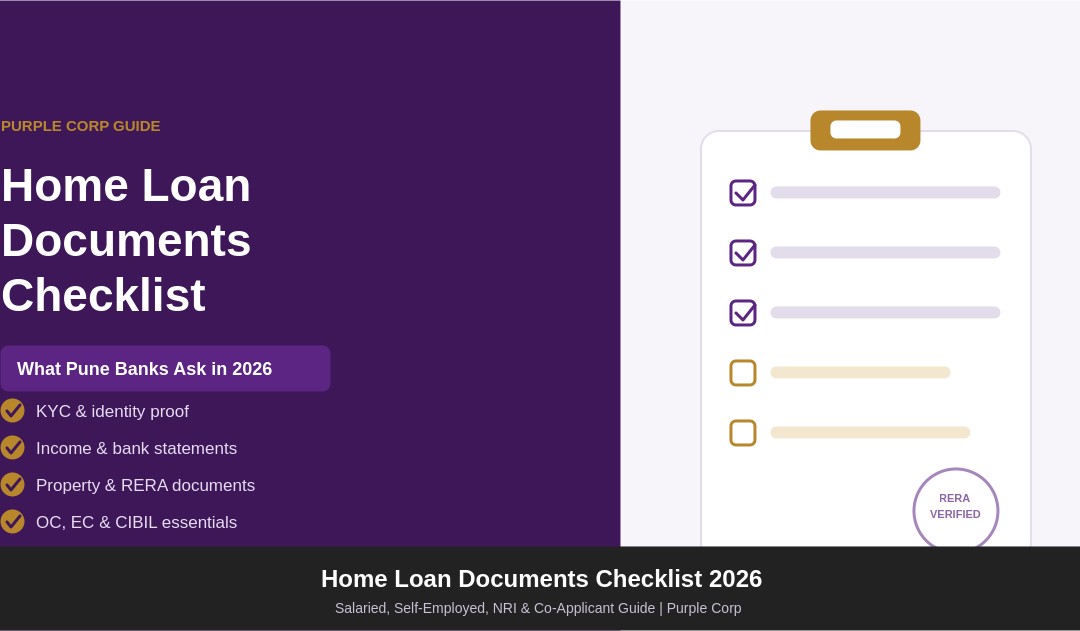
This home loan documents checklist explains the documents that banks and housing finance companies in Pune commonly ask for in 2026. It covers salaried and self-employed applicants, property documents, co-applicants, NRIs and common reasons why applications may be delayed.
Important: This checklist is for general informational purposes only and is not financial or legal advice. Documentation requirements vary between lenders, applicant profiles and property types. Always confirm the exact document list with your chosen bank or housing finance company before applying.
Home Loan Documents Checklist at a Glance
Most home loan applicants should be prepared with documents from the following categories:
| Document Category | Who May Need It |
|---|---|
| KYC and identity/address proof | All applicants |
| Income proof | Salaried and self-employed applicants |
| Bank statements | Most applicants |
| Employment or business proof | Depending on applicant profile |
| Property documents | All property buyers |
| Photographs and application form | All applicants |
| Existing loan documents | Applicants with current loans |
| Additional documents | Co-applicants and NRI applicants, where applicable |
1. KYC and Identity Documents
Banks need documents to verify your identity and address before processing a home loan application.
Commonly requested documents include:
- PAN card
- Aadhaar card
- Passport, Voter ID, or Driving Licence
- Bank passbook or a recent utility bill (electricity, gas, or landline), often accepted as additional address proof
- Recent passport-sized photographs
- Other government-issued identity or address proof accepted by your specific lender
If the address on your identity document differs from your current residential address, the lender may ask for additional address proof.
It is a good idea to keep clear, readable copies of your documents and carry the originals if the lender requires physical verification.
2. Income Proof for Salaried Applicants
If you are a salaried employee, lenders generally evaluate your salary, employment stability, existing financial commitments and repayment capacity.
Common documents include:
- Last 3 months’ salary slips
- Form 16 and/or income tax returns, depending on the lender
- Bank statements showing salary credits, commonly for the last 6 months
- Employment proof confirming your current role and tenure
- Additional income documents, if you have income from other sources
Make sure the salary credited in your bank statement broadly matches the income declared in your application. Differences may result in additional verification.
3. Income Proof for Self-Employed Applicants
Self-employed applicants may need to provide more extensive financial documentation because income is assessed through business and tax records.
Commonly requested documents include:
- Income tax returns for the last 2–3 years
- Computation of income
- Profit and loss statements and balance sheets, often CA-certified
- GST registration or other applicable business registration documents
- Bank statements for both personal and business accounts
- Business continuity or business vintage proof, where required
The exact period and type of financial documents required can vary depending on the lender, business structure and applicant’s profile.
4. Bank Statements
Bank statements help lenders understand your income, regular expenses, existing EMIs and overall financial behaviour.
Many lenders commonly request bank statements covering approximately the previous 6 months, although the required period can vary.
Before submitting your statements, check for:
- Regular salary or business income credits
- Existing loan EMIs
- Large unexplained transactions
- Overdue payments or returned cheques
- Consistency between your bank records and the information provided in your loan application
Keeping your financial records organised before applying can make the verification process easier.
5. Property Documents Required for a Home Loan
Property documentation is an important part of the lender’s legal and technical verification process. The exact documents depend on whether you are purchasing a new property from a developer or buying a resale property.
For a New or Under-Construction Property
Depending on the project and lender, documents may include:
- Agreement for Sale or other applicable sale documentation
- Project MahaRERA registration details
- Approved or sanctioned building plan
- Commencement certificate
- Occupancy Certificate (OC), for ready-possession units — its absence is one of the more common reasons lenders in Pune raise queries on an otherwise eligible application
- Encumbrance Certificate (EC), confirming the property is free of legal or financial liabilities
- Title and ownership-related documents
- Other legal and technical documents requested by the lender
For buyers purchasing a home from a developer, several project-related documents are generally provided or facilitated by the developer for the lender’s verification process. For example, buyers exploring Pune projects such as Park Titan, Park Eden and Park Pebbles can enquire with the project team about the applicable property and project documentation.
For a Resale Property
A resale property may require additional documentation relating to its previous ownership and transaction history. Depending on the property and lender, this can include:
- Previous sale deed or agreement
- Chain of title or previous ownership documents
- Encumbrance Certificate (EC) covering the ownership history
- Society documents and No Objection Certificate (NOC), where applicable
- Property tax receipts
- Approved building plans and Occupancy Certificate, where applicable
- Other documents requested during the lender’s legal verification
Because property documentation can differ significantly between new and resale properties, it is advisable to obtain the lender’s property-document checklist before completing the transaction.
For more information about checking a developer before purchasing, see our guide on How to Verify a Real Estate Developer in Pune.
6. Documents for Co-Applicants
If you are applying for a home loan jointly with a spouse, family member or another eligible co-applicant, the lender will generally require documentation from the co-applicant as well, including:
- KYC and identity documents
- Income proof (salary slips or business financial documents)
- Bank statements
- Photographs
The exact requirements depend on whether the co-applicant has an income and whether that income is being considered for loan eligibility.
7. Additional Documents for NRI Home Loan Applicants
NRIs purchasing property in Pune may need to provide additional documentation to establish their identity, overseas employment and banking details, including:
- Passport and visa or residence permit
- Overseas employment proof or employment contract
- Overseas bank statements and NRE/NRO account statements
- Power of Attorney documents, where someone else is managing the transaction in India
NRI documentation requirements can vary considerably between lenders, so it is advisable to confirm the requirements before submitting your application.
8. Documents for Applicants With Existing Loans
If you already have a home loan, personal loan, car loan or another credit facility, the lender will typically ask for information about your existing liabilities, such as:
- Current loan account statement
- Details of outstanding principal and EMI information
- Repayment history
- Foreclosure or outstanding balance statement, where applicable
Existing EMIs are generally factored into your repayment capacity assessment.
Why Your CIBIL Score Matters Alongside Your Documents
Documentation is only one part of a home loan application. Lenders also assess your credit history, income, existing liabilities, and repayment capacity.
A higher CIBIL score generally improves your credit profile and may help you access more favourable loan terms. Many lenders consider scores around 750 or above favourably, but there is no single score that guarantees approval.
Before applying, consider checking your credit report for:
- Incorrect personal information
- Accounts that do not belong to you
- Incorrect outstanding balances or missed-payment records
- Multiple recent credit enquiries
If you identify an error, resolving it before applying may help avoid unnecessary complications during the loan process.
Do Requirements Differ Between Banks Like SBI, HDFC or Others?
The core document categories — KYC, income proof, bank statements and property papers — are largely similar across major lenders operating in Pune, including SBI, HDFC, ICICI and housing finance companies. Where they tend to differ is in the finer details: each lender has its own application form, may request a slightly different bank-statement period, or may ask for additional undertakings for specific applicant profiles. Once you’ve shortlisted a lender, it’s worth requesting their exact checklist to confirm any small variations from the general list above.
New Property vs Resale Property: What Documents Can Differ?
Property-document requirements are not identical for every purchase.
| New/Developer Property | Resale Property |
|---|---|
| Agreement for Sale | Previous sale deed/agreement |
| MahaRERA registration details | Chain of ownership documents |
| Approved building plan | Encumbrance Certificate (EC) |
| Commencement certificate | Society documents, where applicable |
| Occupancy Certificate, for ready units | Occupancy Certificate, where applicable |
| Other documents requested by the lender | NOC, property tax receipts and other transfer documents |
The lender may request additional documents depending on the project’s stage, property type, location and legal status.
Common Reasons Home Loan Applications Get Delayed
Even when an applicant is financially eligible, incomplete or inconsistent documentation can slow down processing. Common reasons include:
- Salary slips or bank statements that do not match the income declared in the application
- Outdated or incomplete KYC documents
- Missing income-tax or business documents
- Missing Occupancy Certificate or Encumbrance Certificate — a frequently cited rejection reason for Pune properties specifically
- Delays in receiving documents from the seller, society or developer
- Co-applicant documents submitted late
- Existing loan or liability information not disclosed correctly
Preparing your documents before submitting the application can reduce avoidable back-and-forth with the lender.
Home Loan Pre-Application Checklist
- PAN and accepted identity/address proof for all applicants
- Recent passport-sized photographs
- Last 3 months’ salary slips, if salaried
- Form 16 and/or ITR documents
- 2–3 years of ITR and financial documents, if self-employed
- Recent bank statements (approx. 6 months)
- Property documents from the developer or seller, including Occupancy and Encumbrance Certificates where applicable
- MahaRERA registration details and project approvals
- Existing loan statements, if applicable
- Co-applicant documents, if applicable
- NRI documents, if applicable
- Credit report checked before application
FAQ
What documents are needed for a home loan in Pune? Most applicants need KYC documents, income proof, recent bank statements, photographs, an application form and property-related documents. Salaried applicants typically need salary slips and Form 16 or ITR; self-employed applicants typically need ITRs, financial statements and business documents. Exact requirements vary by lender.
What documents are required for a home loan for a salaried person? Typically PAN and identity/address proof, recent salary slips, Form 16 and/or ITR documents, recent bank statements, and employment proof confirming your role and tenure.
What documents are required for a home loan for a self-employed person? Typically ITRs with computation of income, profit and loss statements, balance sheets, bank statements, business registration documents and evidence of business continuity. Some financial documents may need CA certification.
Do requirements differ between banks like SBI and HDFC? The core categories are largely the same across major lenders, though each bank has its own application form and may request small variations. Confirm the exact checklist once you’ve shortlisted a lender.
Do I need MahaRERA details for a home loan? For a RERA-covered property, the lender will typically ask for the project’s MahaRERA registration details as part of its legal and technical verification.
Why do home loans get rejected for Pune properties specifically? A commonly cited reason is a missing Occupancy Certificate (OC) or issues found in the Encumbrance Certificate (EC) during the lender’s legal verification. Confirming these documents are in order before applying can help avoid this.
Is a CIBIL score required for a home loan? Lenders generally assess credit history as part of the process. A higher CIBIL score, typically 750 and above, strengthens your profile, though no single score guarantees approval.
How long does home loan approval take after submitting documents? Processing time varies by lender, applicant profile and documentation completeness. A complete, consistent document set helps reduce avoidable delays — confirm expected timelines with your lender directly.
Can NRIs apply for a home loan in Pune? Yes, subject to lender policies and eligibility criteria. Additional documentation relating to overseas employment, passport/visa status and NRE/NRO banking is typically required.
Do co-applicants need to submit documents for a home loan? Yes, lenders generally require KYC and other relevant documents from co-applicants. If the co-applicant’s income is being considered for eligibility, income and financial documents are also required.
Final Takeaway
A well-prepared document set can make the home loan application process more organised and help reduce avoidable delays.
For most buyers in Pune, the key areas to prepare are KYC documents, income proof, bank statements, credit information and property documents — including the Occupancy and Encumbrance Certificates that are frequently the cause of last-minute delays on Pune properties specifically. Salaried and self-employed applicants have different income-proof requirements, while co-applicants, NRIs and applicants with existing loans may need additional documentation.
Because every lender has its own policies, always request the latest document checklist from your chosen bank or housing finance company before submitting your application.
If you are also researching the legal side of purchasing a home in Pune, read our guide to the Legal Process for Buying Property in Pune: Step-by-Step Buyer Guide.